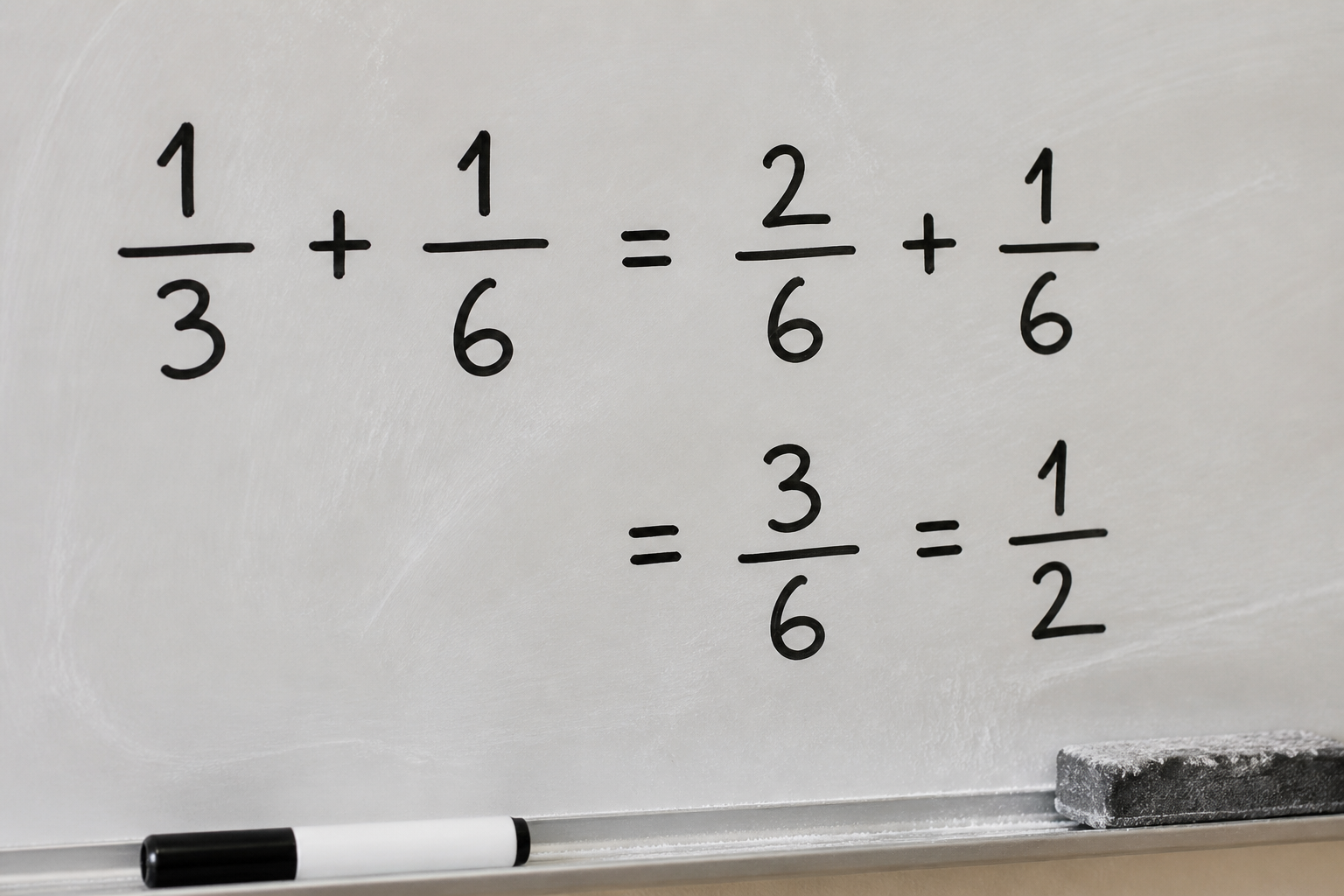
Fractions often seem intimidating, but they're simply a way to represent parts of a whole. Think of a pizza cut into equal slices: each slice is a fraction of the entire pie. Understanding fractions is a fundamental math skill that helps us in cooking, crafting, and even understanding statistics.
Adding fractions comes up in many real-world scenarios. Imagine you're baking and a recipe calls for half a cup of flour for one batch and a third of a cup for another. To find out the total flour needed, you'd add these fractions together. It's a practical skill that extends beyond the classroom.
What Exactly is a Fraction?
A fraction consists of two main parts: a numerator (the top number) and a denominator (the bottom number). The denominator tells us how many equal parts the whole is divided into, while the numerator tells us how many of those parts we have. For example, in 3/4, the "4" means the whole is split into four parts, and the "3" means we have three of those parts.
The Crucial Common Denominator
You can't directly add fractions unless they share the same denominator. This is because you need to be counting the "same size" pieces. If you're adding 1/2 of a pie and 1/4 of a pie, you need to think of both in terms of quarters to add them correctly. Finding a common denominator means finding a number that both original denominators can divide into evenly.
The easiest way to find a common denominator is often to find the Least Common Multiple (LCM) of the denominators. For example, with 1/2 and 1/3, the LCM of 2 and 3 is 6. So, you'd convert both fractions to have a denominator of 6. Convert 1/2 to 3/6 (multiplying top and bottom by 3) and 1/3 to 2/6 (multiplying top and bottom by 2).
Adding Fractions Once Denominators Match
Once your fractions have the same denominator, adding them becomes straightforward. All you do is add the numerators together, and the denominator stays the same. Using our example of 3/6 and 2/6, you'd add 3 + 2 to get 5, keeping the denominator of 6. The sum is 5/6.
It's important not to add the denominators; think of it like collecting items. If you have three apples and two apples, you have five apples, not five "apples-apples." The "type" of item (the denominator) remains consistent.
Simplifying (Reducing) Your Answer
After adding, your resulting fraction might need to be simplified. Simplifying a fraction means reducing it to its lowest terms, where the numerator and denominator have no common factors other than 1. This makes the fraction easier to understand and work with.
To simplify, find the Greatest Common Divisor (GCD) of the numerator and the denominator. Then, divide both numbers by their GCD. For instance, if you have 4/8, the GCD of 4 and 8 is 4. Dividing both by 4 gives you 1/2. Always aim to simplify your fractions to their most reduced form.
Sometimes, your answer might be an improper fraction (where the numerator is larger than the denominator), like 7/4. You can leave it as an improper fraction or convert it to a mixed number (1 and 3/4). The choice often depends on the context of the problem.
When you're working through these steps, our online fraction calculator at /calculators/fraction can be a fantastic tool to check your work or quickly solve more complex problems. It handles all the nitty-gritty of finding common denominators and simplifying for you, allowing you to focus on understanding the concepts.
Mastering fraction addition and simplification empowers you to tackle a wide range of mathematical challenges. It builds a solid foundation for more advanced topics and provides practical skills for everyday life. Keep practicing, and don't hesitate to use resources like CalcBox to help solidify your understanding.