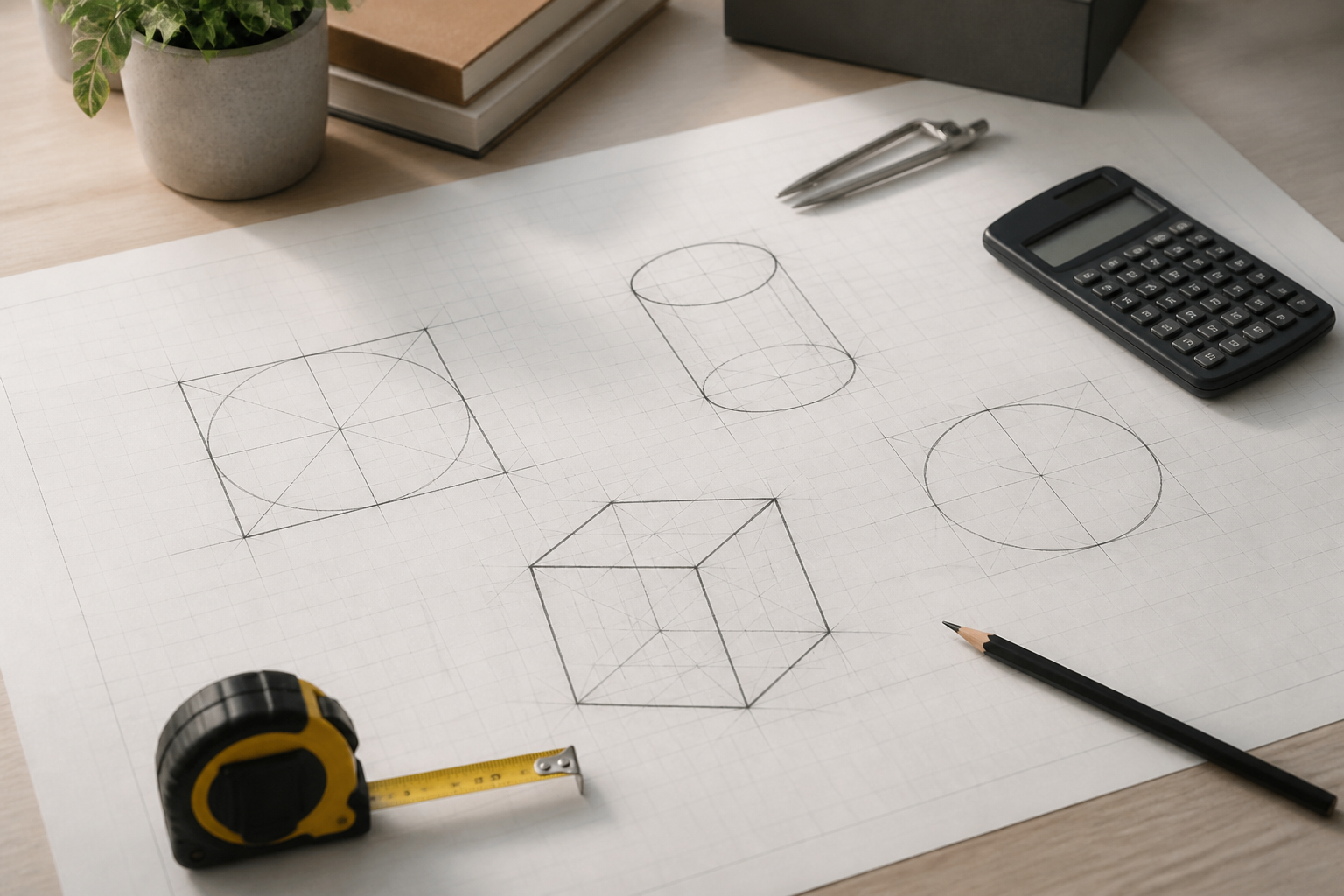
Imagine you're trying to figure out if that new rug will truly fit in your living room. Or maybe you're eyeing a new water tank for your garden and need to know if it'll hold enough for your needs. These aren't just abstract math problems from school; they're everyday dilemmas that hinge on understanding a couple of fundamental concepts: area and volume. Knowing how to calculate these can save you time, money, and a fair bit of frustration.
Area, in simple terms, tells us how much two-dimensional space a flat surface covers. Think about painting a wall or buying carpet – you're dealing with area. Volume, on the other hand, measures the three-dimensional space an object occupies. If you're filling a swimming pool, pouring concrete, or even just packing a box, you're interacting with volume. They sound complex, but once you break them down, they're surprisingly intuitive.
Let's start with area, the measure of surfaces. You're probably familiar with some basic shapes. A square or a rectangle's area is found by multiplying its length by its width. Simple, right? If your living room is 12 feet long and 10 feet wide, its area is 12 feet * 10 feet = 120 square feet. This means you'd need 120 square feet of carpet to cover the entire floor.
Circles are a little different. Their area depends on their radius – the distance from the center to any point on the edge. The formula is π (pi) multiplied by the radius squared (πr²). Pi is a special mathematical constant, approximately 3.14159. So, if you have a circular garden bed with a radius of 5 feet, its area would be π * (5 feet)² = 25π square feet, which is roughly 78.54 square feet. That's a good amount of space for your favorite flowers!
Why does knowing area matter? Beyond home improvement projects, it helps in gardening (how much fertilizer do I need?), crafting (how much fabric for this pattern?), and even understanding things like pressure (force spread over an area). It's a foundational skill.
Diving Into the Third Dimension: Volume
Now, let's add some depth – literally. Volume is about how much 'stuff' can fit inside a three-dimensional object or how much space that object takes up. We usually measure volume in cubic units, like cubic feet, cubic meters, or cubic inches. Think of a shoebox or a can of soda.
For simple rectangular objects, like a cube or a rectangular prism, the formula is straightforward: length × width × height. If you're building a raised garden bed that's 4 feet long, 2 feet wide, and 1 foot high, its volume would be 4 feet × 2 feet × 1 foot = 8 cubic feet. That tells you exactly how much soil you'll need to fill it.
Cylinders are another common shape you'll encounter, from water bottles to storage tanks. To find a cylinder's volume, you first calculate the area of its circular base (remember πr²) and then multiply that by its height. So, the formula is πr²h. Let's say you have a cylindrical rain barrel with a radius of 1.5 feet and a height of 3 feet. The volume would be π * (1.5 feet)² * 3 feet = π * 2.25 square feet * 3 feet = 6.75π cubic feet. That's approximately 21.2 cubic feet of water storage, which is pretty substantial!
A Worked Example: Planning a Home Project
Let's put this into practice with a common home scenario: You want to pour a small concrete slab for a new shed. The slab needs to be 8 feet long, 6 feet wide, and 0.5 feet thick (that's 6 inches). How much concrete do you need?
First, identify the shape: a rectangular prism (the slab).
Second, recall the formula: Volume = Length × Width × Height.
Third, plug in your measurements:
Volume = 8 feet × 6 feet × 0.5 feet
Volume = 48 square feet × 0.5 feet
Volume = 24 cubic feet
So, you'd need 24 cubic feet of concrete. When you order from the supplier, they'll often ask for cubic yards. Since there are 27 cubic feet in 1 cubic yard (3ft x 3ft x 3ft), you'd need 24 / 27 ≈ 0.89 cubic yards. Always round up when ordering materials, so you'd likely order 1 cubic yard to be safe. You don't want to run short!
Common Pitfalls and Practical Tips
One common mistake people make is mixing units. If your length is in feet and your width is in inches, you MUST convert one to match the other before multiplying. Always use consistent units throughout your calculation, or your answer will be wildly off. My advice? Stick to one unit from the start.
Another tip I always give friends: drawing a quick sketch helps visualize the dimensions. It's easy to accidentally swap length and width or forget a height measurement if you're just looking at numbers. A simple drawing can prevent errors.
Don't forget about waste or extra material. When buying paint, wood, or concrete, it's almost always a good idea to factor in a little extra – say 10-15% – for cuts, mistakes, or just in case the initial estimate was slightly off. Better to have a little too much than to run out halfway through a job.
Beyond the Basics: Why These Calculations Matter
Understanding area and volume isn't just about passing a math test. It's about empowering you to make informed decisions. Whether you're calculating the capacity of a storage unit, determining how much wrapping paper you need for a gift, or even estimating the amount of water in a lake, these concepts are constantly at play.
Think about environmental applications: calculating the volume of a reservoir helps manage water resources. In construction, precise area and volume calculations are crucial for structural integrity and cost control. Even in cooking, measuring ingredients by volume is fundamental to a successful recipe. These are truly foundational skills that permeate so many aspects of our lives.
Knowing how to tackle these measurements can give you confidence in many situations, transforming you from someone guessing to someone who knows. It puts you in control.
Frequently Asked Questions (FAQ)
**Q: What's the difference between area and perimeter?**
A: Area measures the space *inside* a 2D shape, like the surface of a table. Perimeter measures the distance *around* the outside edge of a 2D shape, like the fence around a garden. Think of area as covering, and perimeter as outlining.
**Q: Why is 'pi' (π) used for circles and cylinders?**
A: Pi is the ratio of a circle's circumference to its diameter. It's a constant relationship that describes the fundamental geometry of circles. Because the base of a cylinder is a circle, pi naturally shows up in its area and volume formulas.
**Q: Can I use different units for area and volume?**
A: No, you should always use consistent units. If your dimensions are in meters, your area will be in square meters, and your volume in cubic meters. Mixing units will lead to incorrect results.
**Q: Are there more complex shapes I can calculate?**
A: Absolutely! While we focused on squares, circles, cubes, and cylinders, the principles extend to triangles, trapezoids, spheres, cones, and more. Often, complex shapes can be broken down into simpler ones for easier calculation.
Feeling ready to tackle your next measuring challenge? Our specialized tool at /calculators/area-volume can help you quickly and accurately find the area and volume for all these common shapes and more. Give it a try and take the guesswork out of your projects!
What does 'squared' mean in area formulas?
When we say 'squared' (like r²), it means multiplying a number by itself. For example, 5² is 5 × 5 = 25. In the context of area, it results in square units (e.g., square feet) because you're essentially multiplying two lengths together.
How do I calculate the volume of irregular shapes?
For truly irregular shapes, direct formulas are often not available. However, you can often approximate by breaking the irregular shape down into several simpler geometric shapes (like rectangular prisms and cylinders) and calculating the volume of each part, then summing them up. For very complex objects, more advanced methods or specialized software might be used. But for many practical purposes, a good approximation by breaking it down is sufficient.