Fractions are a fundamental part of mathematics, appearing in everything from recipes to financial calculations. Understanding how to work with them – adding, subtracting, multiplying, dividing, and simplifying – is a crucial skill. While they might seem intimidating at first glance, breaking them down into simple steps makes them much more manageable. This guide will walk you through the basics of fraction arithmetic, helping you build confidence in your mathematical abilities.
At its core, a fraction represents a part of a whole. It consists of a numerator (the top number) and a denominator (the bottom number). The denominator tells you how many equal parts the whole is divided into, and the numerator tells you how many of those parts you have. For instance, 1/2 means one part out of two equal parts, or half of something.
Adding and Subtracting Fractions: The Common Denominator
The golden rule for adding or subtracting fractions is that they must have a common denominator. Think of it this way: you can't easily add apples and oranges without converting them to a common unit, like 'fruit.' Similarly, you can't add 1/2 and 1/3 directly because their 'units' (halves and thirds) are different sizes.
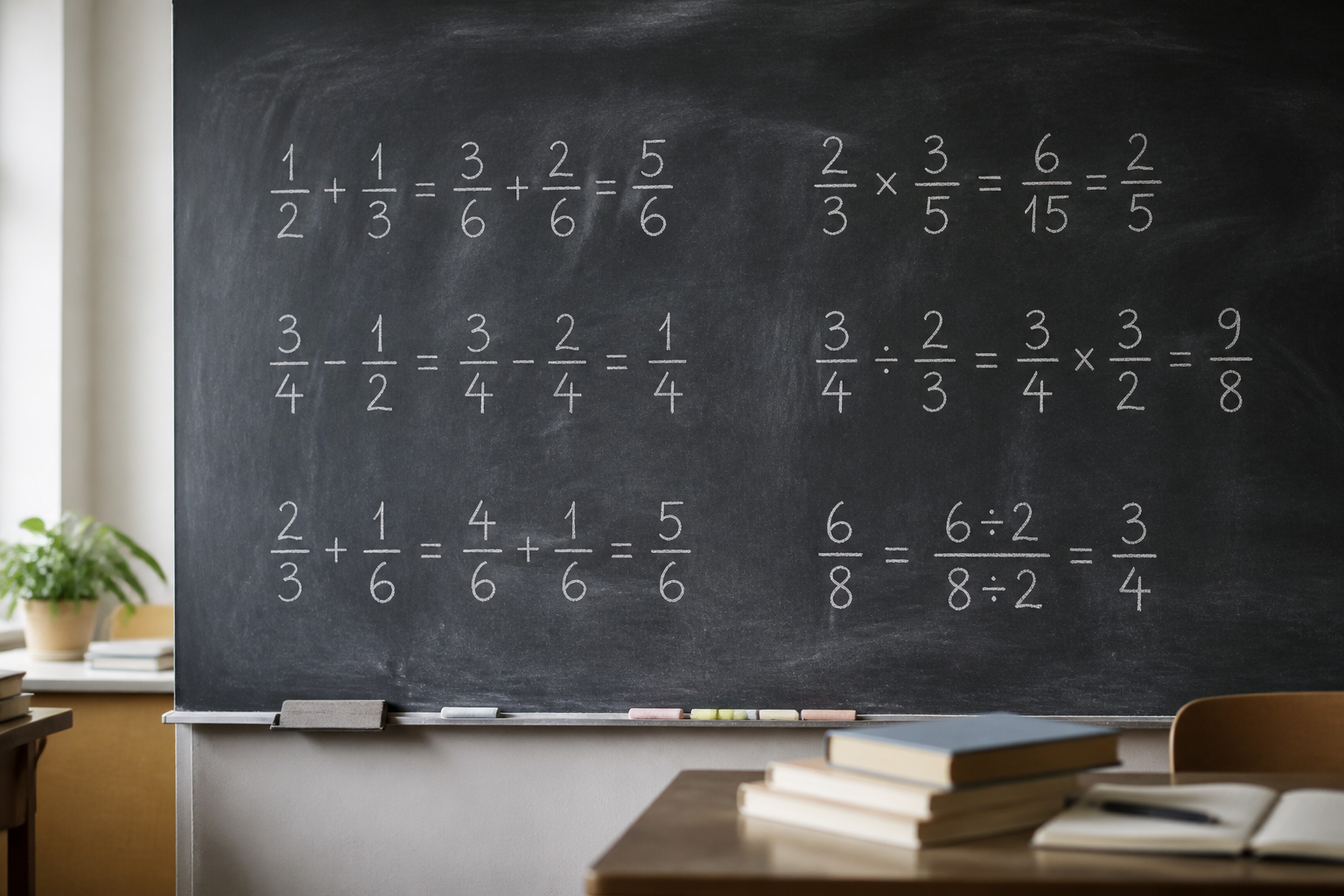
To find a common denominator, you typically look for the least common multiple (LCM) of the denominators. For example, to add 1/2 and 1/3, the LCM of 2 and 3 is 6. You then convert each fraction into an equivalent fraction with 6 as the denominator: 1/2 becomes 3/6 (multiply numerator and denominator by 3), and 1/3 becomes 2/6 (multiply numerator and denominator by 2). Now you can add them: 3/6 + 2/6 = 5/6.
Subtracting fractions follows the same principle. Once you have a common denominator, you simply subtract the numerators. For example, 3/4 - 1/8. The LCM of 4 and 8 is 8. So, 3/4 becomes 6/8. Then, 6/8 - 1/8 = 5/8. Our fraction calculator at /calculators/fraction can quickly handle these conversions and calculations for you, saving time and ensuring accuracy.
Simplifying Fractions: Making Them Understandable
Simplifying a fraction means reducing it to its lowest terms. This makes the fraction easier to understand and work with. A fraction is in its simplest form when the numerator and the denominator have no common factors other than 1. For example, 2/4 can be simplified to 1/2 because both 2 and 4 are divisible by 2.
To simplify a fraction, you find the greatest common divisor (GCD) of the numerator and the denominator. Then, you divide both the numerator and the denominator by their GCD. Take the fraction 10/15. The GCD of 10 and 15 is 5. Dividing both by 5 gives you 2/3. This simplified form is equivalent to the original fraction but is presented in a more concise way.
Beyond the Basics: Mixed Numbers and Improper Fractions
Sometimes you'll encounter mixed numbers, which combine a whole number and a fraction (e.g., 1 1/2). Or you might see improper fractions, where the numerator is greater than or equal to the denominator (e.g., 3/2). Both can be converted to the other form. To convert a mixed number to an improper fraction, multiply the whole number by the denominator, add the numerator, and place the result over the original denominator. For 1 1/2, it's (1 * 2) + 1 = 3, so 3/2.
Conversely, to convert an improper fraction to a mixed number, divide the numerator by the denominator. The quotient is the whole number, and the remainder becomes the new numerator over the original denominator. For 7/3, 7 divided by 3 is 2 with a remainder of 1, so it's 2 1/3. Our fraction calculator handles these conversions automatically.
Why Fractions Matter in Daily Life
Fractions aren't just abstract concepts in a textbook; they're integral to many real-world scenarios. Baking and cooking rely heavily on fractions for ingredient measurements. Carpentry and other construction trades use fractions for precise measurements. Understanding discounts, sales, and financial ratios often involves working with fractions or their decimal equivalents. Even understanding probability and statistics requires a grasp of fractional concepts. Mastering fractions empowers you to make sense of the quantitative world around you.
In conclusion, fractions are a foundational element of mathematics with widespread practical applications. While the rules for adding, subtracting, and simplifying might seem complex initially, they are logical and systematic. By understanding common denominators, greatest common divisors, and the relationship between mixed numbers and improper fractions, you can confidently tackle any fraction problem. Remember, practice makes perfect, and tools like the CalcBox fraction calculator at /calculators/fraction are always available to assist you on your journey to mathematical fluency.