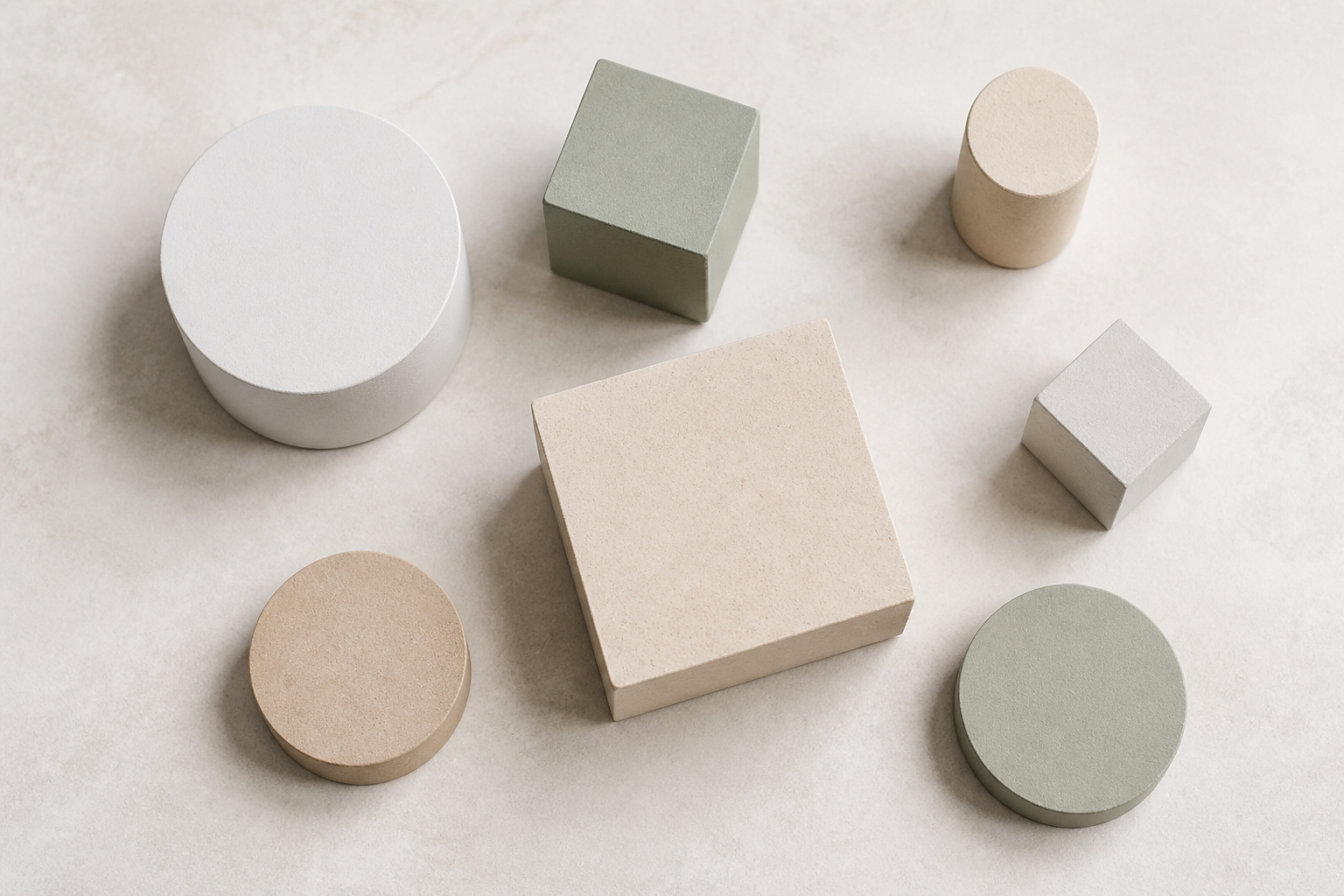
Geometry, at its core, is the study of shapes, sizes, relative positions of figures, and the properties of space. Two fundamental measurements we use to describe these shapes are area and volume. While they both quantify aspects of a shape, they measure very different things. Understanding the distinction and how to calculate each is crucial for many real-world applications, from home improvement to engineering.
Area measures the amount of two-dimensional space a shape covers. Think of it as the surface you could paint or tile. We express area in square units, such as square inches, square feet, or square meters. Different shapes require specific formulas to accurately determine their area, reflecting their unique configurations in a flat plane.
Volume, on the other hand, measures the amount of three-dimensional space an object occupies. It's the capacity a shape has, or how much it can hold. We measure volume in cubic units, like cubic inches, cubic feet, or cubic meters. Just as with area, calculating volume depends entirely on the specific three-dimensional shape in question.
The concepts of area and volume are not just abstract mathematical exercises. They are deeply embedded in our daily lives. Whether you're planning a garden, buying paint for a room, estimating the concrete needed for a patio, or figuring out how much water a tank can hold, you're engaging with area and volume calculations. These mathematical tools help us make informed decisions and visualize the physical world more accurately.
For practical assistance with these computations, the CalcBox "Area and Volume Calculator" at /calculators/area-volume can simplify the process significantly. It allows you to quickly find the area or volume of various common shapes without memorizing every formula.
Unpacking Area: Squares and Circles
Let's start by exploring how to find the area of two common two-dimensional shapes: the square and the circle. These are fundamental building blocks for understanding more complex figures.
A square is a quadrilateral with four equal sides and four right angles. To calculate its area, you simply multiply the length of one side by itself. This can be expressed by the formula: Area = side × side, or A = s². For example, a square garden plot with sides of 5 feet would have an area of 25 square feet, meaning you could cover 25 square foot tiles on its surface.
A circle is a perfectly round shape where every point on its boundary is equidistant from its center. Calculating a circle's area involves its radius, which is the distance from the center to any point on the boundary. The formula is: Area = π × radius², or A = πr². Here, π (pi) is a mathematical constant approximately equal to 3.14159. So, a circular tabletop with a radius of 2 feet would have an area of π × (2 feet)² = 4π square feet, or approximately 12.57 square feet.
Understanding these basic area calculations provides a foundation for more advanced geometric problems. From designing a new floor plan to cutting fabric for a project, knowing how to find area is an invaluable skill.
Delving into Volume: Cubes and Cylinders
Now, let's move into the third dimension and consider the volume of two common three-dimensional shapes: the cube and the cylinder. These shapes appear frequently in manufactured goods and natural forms.
A cube is a three-dimensional solid object bounded by six square faces, with three meeting at each vertex. All its edges are of the same length. To find the volume of a cube, you multiply the length of its side by itself three times. The formula is: Volume = side × side × side, or V = s³. If you have a storage cube with sides measuring 3 meters, its volume would be 3m × 3m × 3m = 27 cubic meters. This tells you how much space the cube occupies or how much it could hold.
A cylinder is a three-dimensional solid with two parallel circular bases and a curved surface connecting them. Think of a soup can or a pipe. To calculate the volume of a cylinder, you multiply the area of its circular base by its height. The formula is: Volume = π × radius² × height, or V = πr²h. If a water tank is a cylinder with a radius of 1 meter and a height of 5 meters, its volume would be π × (1m)² × 5m = 5π cubic meters, or approximately 15.71 cubic meters of water capacity.
These volume calculations are essential in fields ranging from construction, where you might calculate the concrete needed for pillars, to packaging design, where you determine how much product fits into a container. Even in cooking, understanding volume is key for measuring ingredients.
Why Accuracy Matters in Measurement
Precision in area and volume calculations is not just about getting the right answer in a math class; it has tangible impacts in the real world. Underestimating the area of a roof could leave you short on materials, leading to delays and extra costs. Overestimating the volume of a container could mean wasted space or inefficient shipping. In engineering, precise measurements are critical for safety and structural integrity.
Even small errors in measurement can compound, leading to significant discrepancies. This is why tools like the CalcBox Area and Volume Calculator are so valuable. They help minimize human error, providing quick and reliable results based on established mathematical formulas. This ensures that whether you are a student, a DIY enthusiast, or a professional, your calculations are as accurate as possible.
Beyond the Basics: Applications and Further Exploration
The principles of area and volume extend far beyond these basic shapes. Architects use these calculations to design efficient and aesthetically pleasing buildings. Scientists apply them to understand natural phenomena, such as fluid dynamics or the growth of biological structures. Even artists use geometric principles to create balanced compositions. Understanding these foundational concepts opens doors to appreciating the world around us with a deeper, more analytical perspective.
As you continue to explore geometry, you'll find that most complex shapes can be broken down into simpler components. For instance, an irregular plot of land might be divided into squares, rectangles, and triangles to calculate its total area. Similarly, a complex machine part could have its volume calculated by summing the volumes of its cylindrical and cubic sections. This modular approach makes seemingly daunting problems manageable.
The ability to accurately measure and understand area and volume is a powerful skill. It empowers you to solve practical problems, visualize spatial relationships, and make informed decisions in a multitude of contexts. Whether you are laying new flooring, packing a moving truck, or studying for an exam, these geometric concepts are indispensable tools. Take advantage of resources like the CalcBox Area and Volume Calculator to build confidence and accuracy in your measurements.