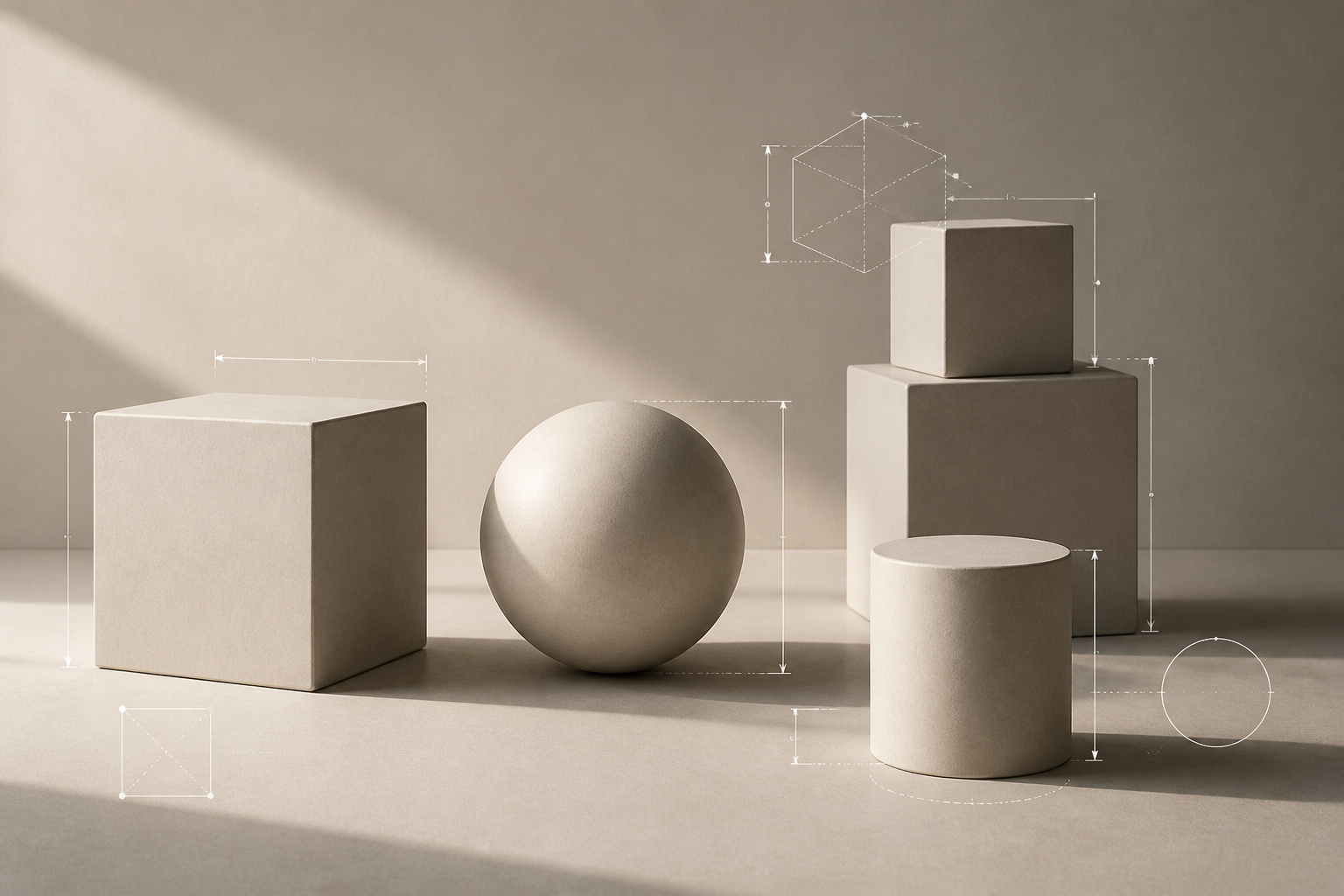
Understanding area and volume goes beyond the classroom; it's a fundamental skill that applies to countless real-world scenarios. From home improvement projects to packing a moving truck, knowing how to calculate the space occupied by a two-dimensional surface or a three-dimensional object empowers you to make informed decisions and avoid costly mistakes. This guide will walk you through the basics of area and volume, focusing on common geometric shapes, and highlight how easily you can perform these calculations with our handy tool.
Area is the measure of the space inside a two-dimensional shape. Think of it as the amount of paint you'd need to cover a wall or the quantity of carpet required for a room. It's always expressed in square units, such as square feet (ft²) or square meters (m²). Common shapes like squares, rectangles, and circles each have their own straightforward formulas for calculating area.
Volume, on the other hand, measures the amount of space an object occupies in three dimensions. Imagine how much water a swimming pool holds or the capacity of a storage box. Volume is expressed in cubic units, like cubic feet (ft³) or cubic meters (m³). We usually encounter volume with shapes such as cubes, cylinders, and spheres.
Cubes are perhaps the simplest three-dimensional shapes. All their sides (or edges) are of equal length. To find the volume of a cube, you simply multiply the length of one side by itself three times (side × side × side, or side³). For example, a cube with a side of 5 feet would have a volume of 125 cubic feet.
Cylinders are another common shape, found in everything from soup cans to water pipes. A cylinder has two parallel circular bases and a curved surface connecting them. To calculate its volume, you need the area of its circular base (πr², where 'r' is the radius) multiplied by its height (h). So, the volume of a cylinder is πr²h.
Knowing how to calculate area can save you money and time. If you're tiling a bathroom floor, you'll need to know its area to purchase the correct number of tiles, minimizing waste and extra trips to the store. Similarly, when painting a room, calculating the wall area helps you buy just enough paint, preventing overspending or running short mid-project.
Volume calculations are equally practical. When planning a move, understanding the volume of your belongings helps you choose the right size moving truck or storage unit, avoiding the inconvenient and costly need for additional space. In gardening, knowing the volume of a raised garden bed allows you to determine how much soil you'll need. These everyday examples demonstrate the importance of mastering these basic geometric concepts.
We've covered the fundamental concepts of area and volume for some common shapes. While the formulas are generally simple, remember that precision in your measurements is key to accurate results. For quick and reliable calculations, especially when dealing with various units or complex projects, our online Area and Volume Calculator can be a tremendous asset. It simplifies the process, allowing you to input your dimensions and instantly get the area or volume you need. Visit /calculators/area-volume to try it out!
Whether you're a student learning geometry or an adult tackling a home improvement project, having a solid grasp of area and volume is incredibly useful. These calculations are not just abstract math problems; they are tools that empower you to navigate the physical world more efficiently and confidently. Take advantage of the resources available, like our calculator, to make these measurements easy and accurate, saving you time, money, and hassle in the long run.