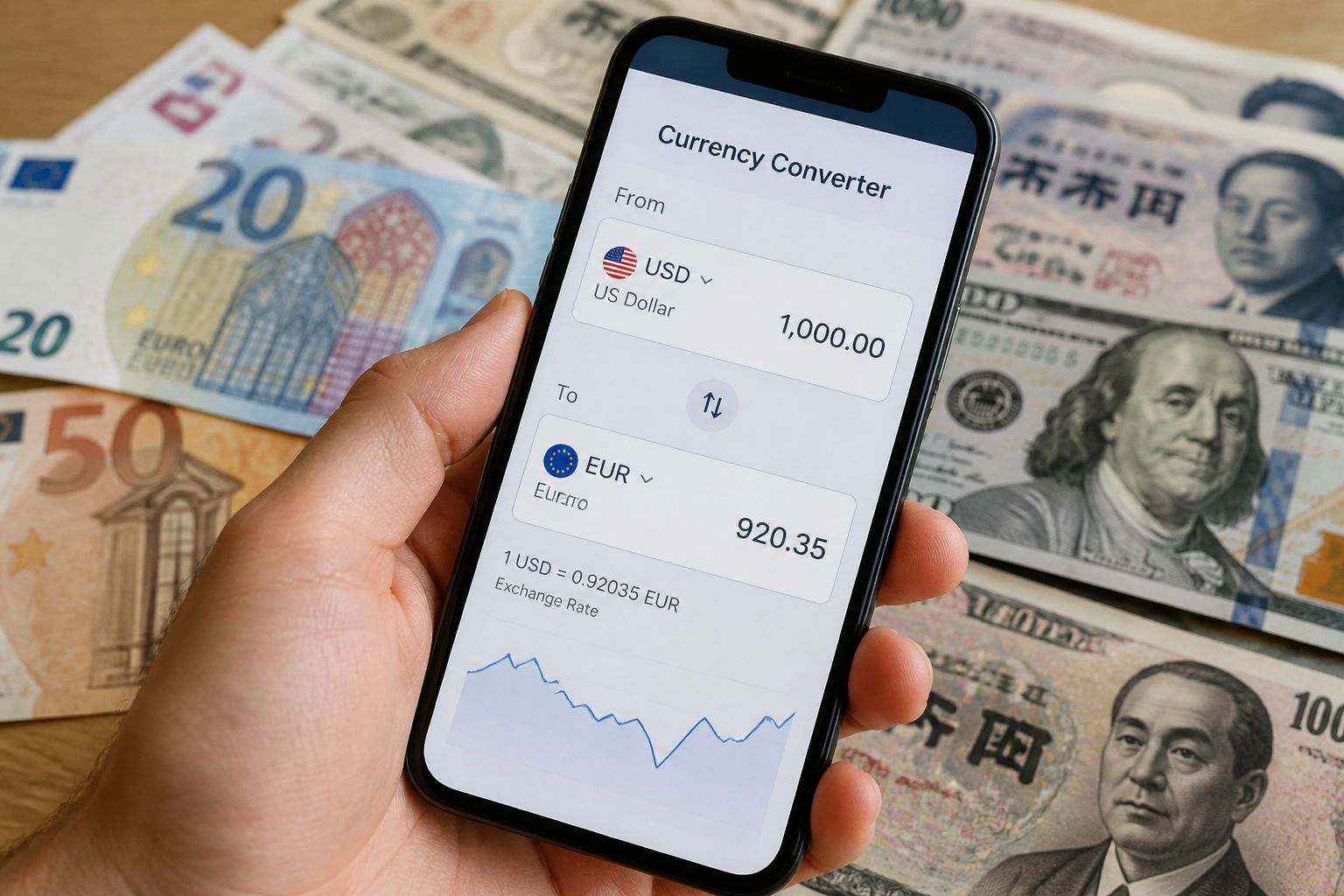
Ever wondered how much that souvenir truly costs when you're traveling abroad, or if buying those online shoes from a foreign website is really a good deal? The answer lies in understanding currency conversion. In our increasingly globalized world, money frequently crosses borders, whether you're vacationing in a different country, sending funds to family overseas, or purchasing goods from an international vendor. Knowing how to accurately convert one currency into another is a fundamental skill that empowers you to make smarter financial choices.
At its core, currency conversion is the process of changing money from one currency to another using a specific rate. This rate, known as the exchange rate, tells you how much one unit of a particular currency is worth in terms of another. For example, if the exchange rate between the US Dollar (USD) and the Euro (EUR) is 1 USD = 0.92 EUR, it means one US dollar can buy 0.92 Euros. This simple concept underpins all international financial transactions.
The primary reason for needing a currency converter is to understand the true value of money in a foreign denomination. Without it, you're essentially guessing, which can lead to overspending or missed opportunities. For travelers, it means accurately budgeting for expenses like meals, accommodation, and activities. For online shoppers, it helps compare prices across different countries to find the best deal. Businesses rely on precise conversions for international trade, invoicing, and financial reporting. Even individuals sending money internationally need to know how much the recipient will actually receive after conversion and fees.
How Exchange Rates Work: The Basics
Exchange rates are essentially the price of one currency expressed in another. They are constantly fluctuating due to a myriad of economic and geopolitical factors. Think of it like any other commodity; its price goes up or down based on supply and demand. If many people want to buy Euros using US Dollars, the Euro's value might increase relative to the Dollar. Conversely, if there's high demand for US Dollars from Euro holders, the Dollar might strengthen.
Key factors influencing exchange rates include interest rates set by central banks, a country's economic stability and growth prospects, inflation rates, political stability, and even significant news events. Major economic announcements, changes in government policy, or even natural disasters can all send ripples through the foreign exchange markets, causing rates to shift rapidly. This constant movement is why relying on an old exchange rate can be risky.
There are generally two main ways exchange rates are quoted: direct and indirect. A direct quote expresses the value of one unit of foreign currency in terms of the domestic currency (e.g., 1 EUR = 1.08 USD if you're in the US). An indirect quote expresses the value of one unit of domestic currency in terms of the foreign currency (e.g., 1 USD = 0.92 EUR). Most currency converters, like the one found at /calculators/currency-converter, make this distinction seamless, allowing you to easily input your desired currencies and get the conversion you need.
Understanding Bid, Ask, and Spread
When you look up exchange rates, you might sometimes see two slightly different numbers: the 'bid' rate and the 'ask' rate. The bid rate is the price at which a bank or currency exchange will buy a currency from you. The ask rate (sometimes called the offer rate) is the price at which they will sell it to you. The difference between these two rates is known as the 'spread.'
The spread represents the profit margin for the financial institution facilitating the exchange. For instance, if the bid for EUR/USD is 1.0790 and the ask is 1.0810, the bank will buy your Euros for 1.0790 USD each but sell them to you for 1.0810 USD each. This spread is a normal part of the foreign exchange market. When using a currency converter, you're typically seeing a mid-market rate, which is an average of the bid and ask prices and represents the true value of the currency without institutional markups. Always be aware that when you actually exchange money, the rate you receive will include this spread, as well as any additional fees.
Practical Applications: When You Need a Currency Converter
The usefulness of a reliable currency converter extends far beyond just curiosity. Here are some common scenarios where it becomes an indispensable tool:
1. **International Travel:** Before and during a trip, knowing the current exchange rate helps you budget accurately. You can estimate daily expenses, compare prices for tours or hotels, and decide whether it's cheaper to pay in local currency or your home currency (often local currency is better).
2. **Online Shopping:** Many international websites display prices in their local currency. A converter allows you to instantly see the cost in your home currency, helping you decide if a deal is truly worth it, especially when factoring in shipping and potential import duties.
3. **Sending Money Abroad:** Whether it's remittances to family, paying for overseas services, or transferring funds between your own international accounts, a converter helps you understand exactly how much the recipient will receive. This is crucial for comparing different money transfer services, which often offer varying rates and fees.
4. **Investing and Business:** Investors in foreign stocks or bonds, and businesses engaged in international trade, constantly monitor exchange rates. Fluctuations can significantly impact the value of investments or the profitability of cross-border transactions. A converter provides real-time insights to inform financial strategies.
5. **Personal Finance Tracking:** If you have income or expenses in multiple currencies, a converter helps you consolidate everything into a single currency for budgeting and financial planning.
Beyond the Calculator: Tips for Smart Currency Exchange
While our currency converter at /calculators/currency-converter gives you the most up-to-date exchange rate, here are some additional tips to ensure you get the best value when making actual transactions:
1. **Avoid Airport Exchange Counters:** These often have the worst exchange rates and highest fees due to convenience. Plan ahead if you need foreign cash.
2. **Use Local ATMs Strategically:** Withdraw local currency from ATMs affiliated with major banks. Be aware of potential foreign transaction fees from your bank and ATM operator fees. Always choose to be charged in the local currency if the ATM offers a choice (this avoids Dynamic Currency Conversion, where the ATM provider uses an unfavorable rate).
3. **Credit Cards with No Foreign Transaction Fees:** Many credit cards offer the interbank rate (or very close to it) and waive foreign transaction fees, making them an excellent option for purchases abroad. Just be sure to pay in the local currency at point-of-sale.
4. **Monitor Rates:** If you have a large transaction coming up, keep an eye on exchange rates using a converter. If the rate moves in your favor, it might be a good time to make the exchange.
5. **Be Aware of Hidden Fees:** Beyond the exchange rate spread, some banks and transfer services charge explicit fees. Always factor these into your total cost.
Common Currency Conversion Questions
**Q: Are currency converter rates 'real-time'?**
A: Many online currency converters, including the one at CalcBox, use data feeds that are updated frequently, often every few minutes or even seconds, making them very close to real-time market rates. However, the exact rate you get from a bank or exchange service will include their spread and potentially fees.
**Q: Why do exchange rates change so much?**
A: Exchange rates are influenced by a complex interplay of global economic factors, including interest rates, inflation, political stability, economic growth, and supply and demand for currencies. These factors are constantly shifting, causing rates to fluctuate.
**Q: Is it better to exchange money before I travel or in the destination country?**
A: Generally, it's better to exchange a small amount before you leave for immediate expenses and then withdraw larger amounts from ATMs in your destination country using a debit card with low or no foreign transaction fees. Avoid exchanging large sums at airport kiosks. Paying with a credit card that has no foreign transaction fees is often the most cost-effective for purchases.
**Q: What is Dynamic Currency Conversion (DCC)?**
A: DCC is an optional service offered at merchants or ATMs abroad where you are given the choice to pay or withdraw in your home currency rather than the local currency. While it might seem convenient, the exchange rate used by the merchant or ATM operator is often significantly worse than your bank's rate, leading to higher costs. Always choose to be charged in the local currency.
In a world where borders are increasingly porous for commerce and travel, understanding currency conversion is a vital financial literacy skill. With tools like the CalcBox currency converter at your fingertips, you can navigate international transactions with confidence and ensure your money goes further, no matter where you are or what currency you're dealing with. Make informed decisions and take control of your global finances today!