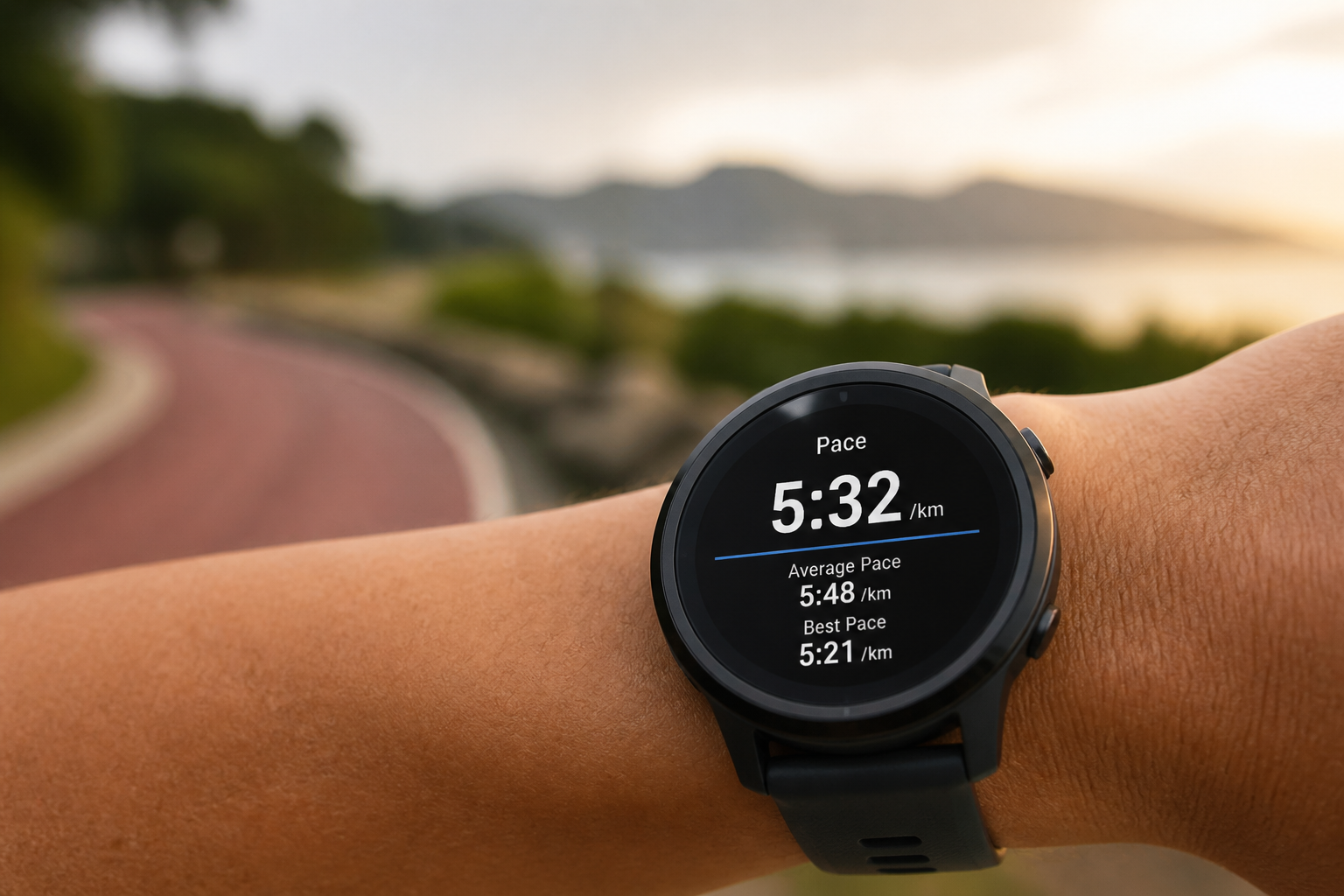
You've just finished a fantastic run, legs burning but spirits high. You glance at your watch: 35 minutes and 30 seconds for a 5-kilometer route. That's great, right? But what does it *really* mean for your speed? And how can you use that information to improve your next run, or even predict your time for a longer race? Understanding your running pace is the key to unlocking these insights.
Many runners, especially when starting out, focus solely on distance and time. While those are crucial metrics, pace brings them together into a single, actionable number. Your pace tells you how long it takes you to cover a specific unit of distance – typically minutes per mile or minutes per kilometer. Knowing this allows you to train smarter, set realistic race goals, and even recover more effectively.
Think of it this way: if you drove for an hour, you wouldn't just say "I drove for an hour." You'd want to know how far you went, and your average speed. Running is no different. A 7-minute mile pace feels different than an 11-minute mile pace, and each serves a different purpose in your training plan. The beauty of pace is its versatility; it can be applied to a casual jog, a tempo run, or a full marathon.
So, what exactly *is* running pace? At its core, pace is a simple division: total time divided by total distance. If you ran 3 miles in 27 minutes, your pace is 9 minutes per mile. Easy enough, right? But when you start dealing with mixed units – say, a race measured in kilometers and you prefer miles, or a time that includes seconds – the mental math can become a bit trickier. This is where tools like the running pace calculator at /calculators/pace become invaluable.
Let's break down a quick example to show you how pace works in practice. Imagine you just completed a 10K race (which is 6.21 miles) in exactly 50 minutes. To find your pace per kilometer, you'd divide 50 minutes by 10 kilometers, giving you a pace of 5 minutes per kilometer. To convert that to minutes per mile, it gets a bit more involved, but roughly, 5 minutes/km is about 8 minutes and 3 seconds per mile.
This calculation, while straightforward, highlights a common pitfall: consistency. Your pace isn't static throughout a run. Hills, fatigue, hydration, and even a strong headwind can all affect it. An average pace gives you a good benchmark, but don't forget that the actual pace you maintained moment-to-moment varied. For advanced training, you might look at "split paces" – the pace you held for each mile or kilometer segment.
### Why Your Pace Matters for Training
Understanding your running pace is like having a secret weapon for your training. It helps you structure your workouts much more effectively than just "running until you're tired." Different types of runs demand different paces:
• **Easy Runs:** These are the backbone of most training plans. You should be able to hold a conversation comfortably. Your pace here might be 1-2 minutes slower than your typical race pace.
• **Tempo Runs:** These are sustained, comfortably hard efforts, usually lasting 20-40 minutes. Your pace should be challenging, but not all-out. It builds your lactate threshold, improving your ability to sustain faster speeds.
• **Intervals/Speed Work:** Short, fast bursts followed by recovery. These are much faster than your race pace and are designed to improve speed and efficiency.
• **Long Runs:** These build endurance. Your pace should be relaxed, usually slightly slower than your easy run pace, especially as you add mileage.
Knowing your current average pace helps you dial in these different intensities. If your 10K race pace is 8 minutes per mile, your easy runs might be 9:30-10:00 per mile, and your tempo runs might be closer to 7:45 per mile. Without a baseline pace, it's just guesswork, and that can lead to overtraining or undertraining.
### Calculating Your Pace: A Step-by-Step Example
Let's walk through a practical scenario. Suppose you want to run a half marathon (13.1 miles) and your goal is to finish in 2 hours and 15 minutes.
1. **Convert time to a single unit:** 2 hours and 15 minutes is (2 * 60) + 15 = 120 + 15 = 135 minutes.
2. **Divide total time by total distance:** 135 minutes / 13.1 miles = 10.305 minutes per mile.
3. **Convert the decimal back to seconds:** 0.305 minutes * 60 seconds/minute = 18.3 seconds. We can round this to 18 seconds for practical purposes.
So, your target pace for the half marathon is 10 minutes and 18 seconds per mile. This gives you a concrete number to aim for during your training runs. If you find yourself consistently running faster than this pace on your long runs, you might be overdoing it. If you're significantly slower, you might need to adjust your training or your goal.
### Common Mistakes and How to Avoid Them
One of the most common mistakes I see runners make is comparing their pace directly to others without considering context. Your running pace is personal. What's fast for one person might be a recovery jog for another. Don't get discouraged by someone else's numbers; focus on *your* progress.
Another frequent error is trying to maintain race pace on every single run. This is a fast track to injury and burnout. Remember the different types of runs we talked about? Varying your pace is essential for balanced training and continuous improvement. Your body needs those slower runs to recover and build endurance without excessive stress.
Finally, relying solely on your watch for pace tracking can sometimes be misleading. GPS signals can be spotty, especially in urban environments or heavily wooded areas, leading to inaccurate readings. While technology is great, always listen to your body first. Use perceived effort alongside your pace data.
### Beyond the Numbers: Pace and Your Running Journey
Pace isn't just about speed; it's about control. When you understand your pace, you gain control over your effort, your training, and ultimately, your race day performance. It helps you avoid going out too fast and "bonking" later in a race, a common and frustrating experience. By practicing different paces in training, you teach your body how to manage energy efficiently.
For instance, if you're training for a marathon, you'll want to get comfortable with your target marathon pace, but also know what a slightly faster "tempo" pace feels like, and a much slower "easy" pace. This range allows you to adapt to race conditions, whether it's tackling a hill or picking up the speed for the last mile.
A good practical tip I'd give a friend is this: instead of just setting out to run X miles, try setting out to run for X minutes at Y pace. This shifts your focus from just logging miles to performing a specific workout with intent. It makes every run a targeted training session.
### FAQs About Running Pace
**Q: What's a "good" running pace?**
A: "Good" is subjective! A good pace for you is one that aligns with your fitness level, training goals, and the type of run you're doing. Don't compare yourself to elite athletes. Focus on improving *your* pace over time.
**Q: How can I improve my running pace?**
A: Improving your pace involves a combination of consistent training, incorporating speed work (intervals, tempo runs), increasing your overall mileage gradually, strength training, and proper nutrition and recovery. Consistency is key!
**Q: Does running pace affect calorie burn?**
A: Yes, generally, running at a faster pace (lower minutes per mile/km) burns more calories per unit of time because your body is expending more energy. However, running for a longer duration at a slower pace might burn more total calories.
**Q: What's the difference between pace and speed?**
A: Pace is typically expressed as time per unit of distance (e.g., 8 minutes per mile). Speed is distance per unit of time (e.g., 7.5 miles per hour). They are inversions of each other. Most runners use pace because it's easier to think about how long it takes to cover a mile than how many miles you cover in a minute.
Your running journey is unique, and understanding your pace is a powerful tool to make that journey more rewarding. It takes the guesswork out of training and helps you make informed decisions about your efforts. Ready to calculate your next run? Head over to the CalcBox running pace calculator at /calculators/pace to quickly figure out your average speed, target pace, or predicted finish time.