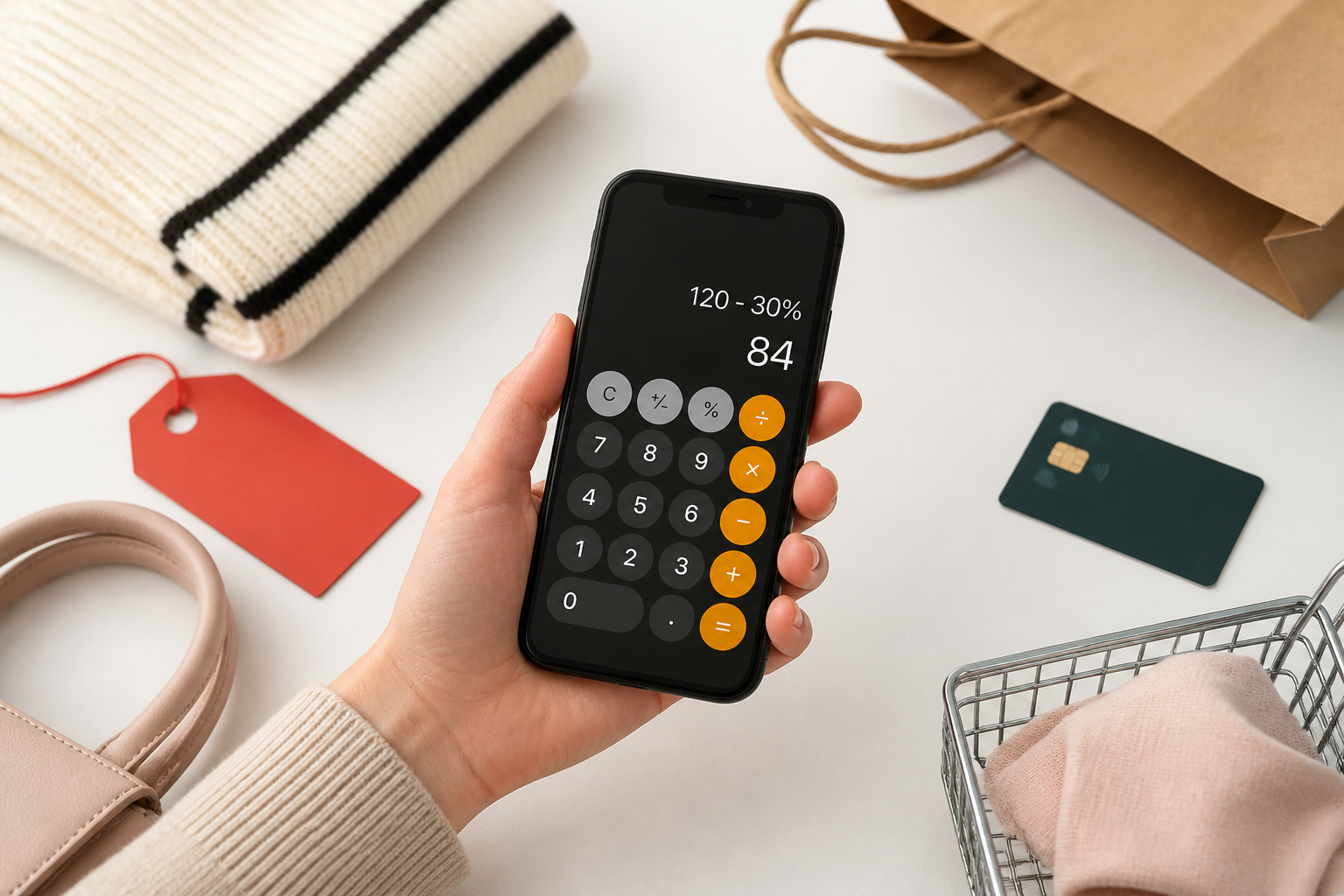
Picture this: You're standing in line, phone in hand, eyeing that 20% off sign on a shirt that was originally $49.99. Another sign says "extra 15% off at checkout!" Your mind starts racing. Is it really a good deal? How much will you actually pay? Do they stack? This isn't just about a shirt; it’s about making smart financial choices in real-time, whether it's for groceries, electronics, or that big-ticket item you've been saving for. Knowing how to quickly crunch those numbers can be the difference between a savvy purchase and feeling like you overpaid.
Most of us have been there – trying to do mental math for discounts, especially when multiple percentages are involved. It’s easy to get confused. Let me walk you through the simple math behind discounts, show you how to avoid common mistakes, and how a good discount calculator, like the one at /calculators/discount, can be your best shopping buddy.
The Basic Math of Finding Your Savings
Let's start with a single discount. The core idea is to figure out what part of the original price you *won't* be paying. If something is 25% off, it means you'll pay 75% of the original price (100% - 25% = 75%).
**Example:** You want to buy a new blender that costs $120. It's on sale for 20% off.
* **Method 1: Find the discount amount first.**
* Discount amount = 20% of $120
* Discount amount = 0.20 * $120 = $24
* Final price = Original price - Discount amount
* Final price = $120 - $24 = $96
* **Method 2: Find the remaining percentage.**
* Percentage you pay = 100% - 20% = 80%
* Final price = 80% of $120
* Final price = 0.80 * $120 = $96
Both methods give you the same result: you save $24, and the blender costs $96. Simple, right? But what happens when you have multiple discounts?
Stacking Discounts: The Order Matters!
This is where many people get tripped up. Imagine that $120 blender is 20% off, but today, there's an *additional* 10% off for store cardholders. Do you just add the percentages (20% + 10% = 30%) and take 30% off $120? Absolutely not! This is a classic mistake that can cost you money.
Discounts are almost always applied sequentially. That "additional" discount comes *off the already discounted price*. Let's revisit our blender example:
* **Original Price:** $120
* **First Discount:** 20% off
* **Price after first discount:** $96 (as calculated above)
* **Second Discount:** Additional 10% off the $96 (not the original $120)
* Discount amount = 10% of $96
* Discount amount = 0.10 * $96 = $9.60
* Final price = $96 - $9.60 = $86.40
If you had mistakenly added the percentages (30% off $120), you would have gotten $120 * 0.70 = $84. That's a $2.40 difference! While it might seem small on a single item, these errors can add up significantly on bigger purchases or during a shopping spree.
Always remember: **sequential discounts compound, they don't simply add up.** This is a practical tip I'd give any friend: when you see "additional percentage off," apply it to the *current* sale price, not the original.
Why a Discount Calculator is Your Secret Weapon
Manually calculating discounts, especially stacked ones, can be tedious and prone to errors. This is where a dedicated tool like the CalcBox discount calculator at /calculators/discount becomes incredibly useful. You simply input the original price, the percentage discount, and if there's a second or even third discount, you can add those too. The calculator does the heavy lifting instantly, showing you:
* The final price after all discounts.
* The total amount you saved in dollars.
* The effective total percentage discount.
This instant feedback allows you to make quick, informed decisions. Is that TV really a good deal with the 25% off *plus* another 10% if you sign up for their loyalty program? Pop the numbers into the calculator, and you'll know in seconds if it fits your budget and if the savings are worth the extra step.
Beyond Shopping: Other Uses for Discount Calculations
Understanding percentage discounts isn't just for retail therapy. It’s a foundational math skill with many real-world applications:
* **Budgeting:** When planning your monthly expenses, knowing how to calculate potential savings on groceries or utilities can help you allocate funds more effectively.
* **Investing:** While not a discount in the traditional sense, understanding percentage changes is crucial for tracking stock performance or investment returns.
* **Business:** If you run a small business, offering discounts strategically requires knowing exactly how much it impacts your profit margins.
* **Negotiation:** Whether buying a used car or haggling at a flea market, knowing how to quickly calculate offers and counter-offers based on percentages gives you an edge.
Even things like calculating sale tax (which is essentially an "add-on percentage") or tips in a restaurant use the same basic principles of percentage math. Mastering discounts gives you a better grasp of all these financial interactions.
Common Mistakes to Avoid
I already mentioned the biggest one – incorrectly adding sequential discounts. But here are a couple more pitfalls to watch out for:
* **Misunderstanding the "Up To" Discount:** A sign that says "Up to 50% off!" doesn't mean everything is half price. It means *some* items might be, while others could be 10% or 20% off. Always check the specific item's tag.
* **Ignoring the Total Cost:** Sometimes, a discount makes an item seem cheap, but if you have to buy a lot of accessories or pay high shipping fees, the overall value might diminish. Always consider the total out-of-pocket expense.
* **Focusing Only on Percentage:** A 50% discount on a $10 item is only $5 in savings. A 10% discount on a $1000 item is $100 in savings. The percentage itself isn't the only measure of a good deal; the actual dollar amount saved matters just as much, if not more, to your wallet.
When in doubt, use your discount calculator. It's there to give you clarity, not just another number.
Wrapping Up Your Savings
Whether you're a seasoned bargain hunter or just trying to be smarter with your money, understanding how to calculate discounts is an invaluable skill. It empowers you to make confident purchasing decisions, avoid common traps, and truly maximize your savings.
Don't let complicated percentages or stacked offers deter you. With the simple math we covered and the convenience of an online tool, you'll be calculating your way to bigger savings in no time. Head over to the CalcBox discount calculator at /calculators/discount and see for yourself how easy it is to find out your final price and exactly how much you're saving on your next purchase. Happy shopping!