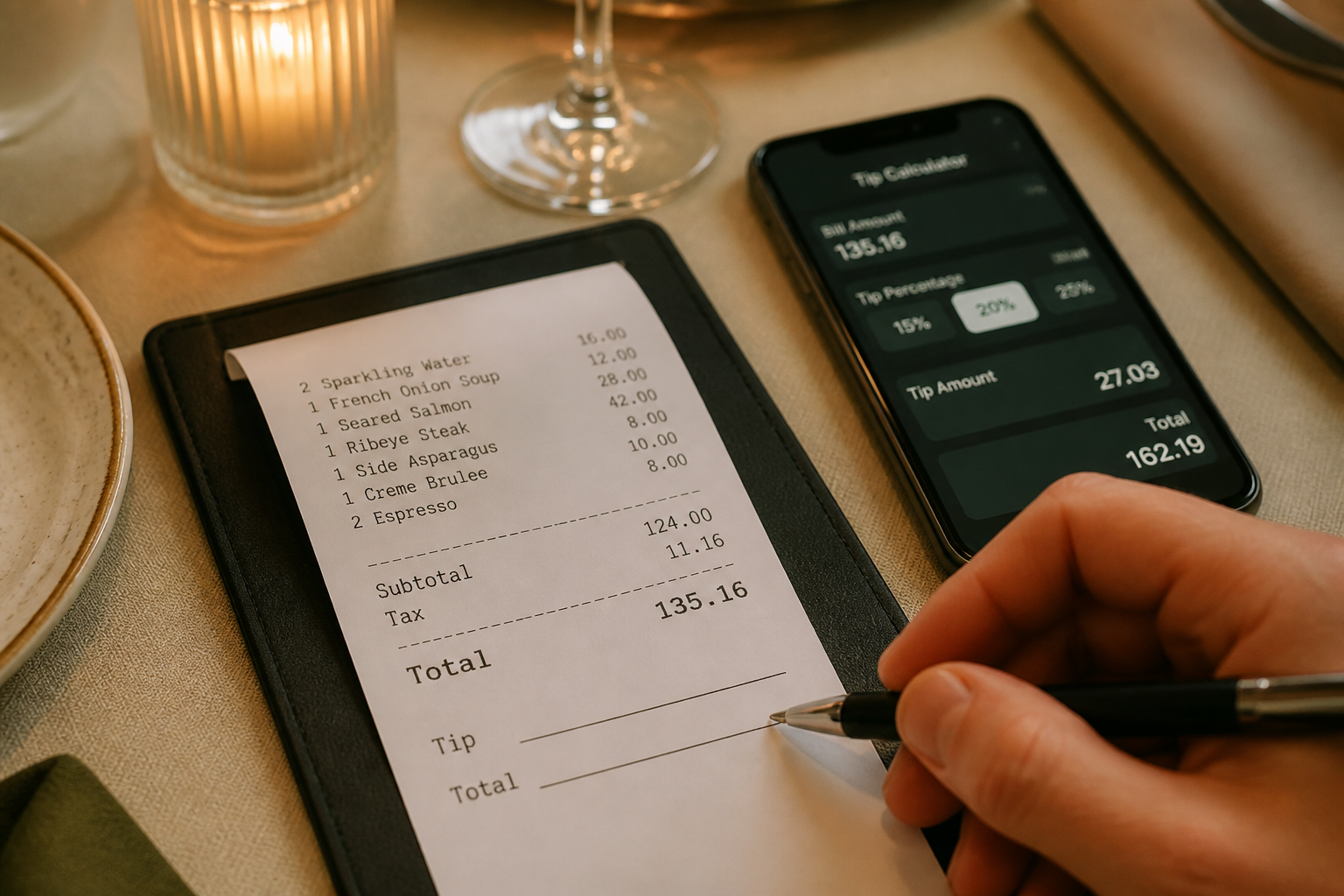
Dining out is a delightful experience, a chance to savor delicious food, enjoy good company, and take a break from cooking. However, the end of the meal often brings a moment of confusion: how much should you tip, and how do you fairly split the bill, especially with a larger group? Getting these calculations right can feel like a mini-math challenge after a satisfying meal, but it doesn't have to be complicated.
Understanding tipping etiquette is more than just good manners; it's about recognizing and appreciating the hard work of your servers, bartenders, and other service staff. While tipping percentages can vary by country, region, and type of service, a general guideline helps ensure you're showing appropriate gratitude. For standard restaurant service in many Western countries, a tip ranging from 15% to 20% of the pre-tax bill is common, with higher percentages for exceptional service.
Why Tipping Matters: Beyond Just a Number
Tipping serves as a significant portion of income for many service professionals. It acts as an incentive for excellent service and directly reflects your satisfaction with the dining experience. A thoughtful tip acknowledges the effort put into preparing your food, serving your table, and ensuring your comfort. Conversely, a low or absent tip can communicate dissatisfaction, signaling areas where service might improve.
However, tipping can sometimes be confusing. Should you tip on the pre-tax or post-tax amount? What if a service charge is already included? Generally, it's recommended to tip on the pre-tax amount to avoid tipping on a tax. If a service charge, often around 18-20%, is already added to your bill, especially for larger parties, you might not need to add an additional tip unless you feel the service was truly outstanding and warranting more. Always check your bill carefully to avoid double-tipping.
The Simple Math of Tip Calculation
Calculating a tip doesn't require advanced arithmetic. Let's say your bill is $50, and you want to leave a 15% tip. You would multiply $50 by 0.15, which equals $7.50. Add this to your original bill ($50 + $7.50), and your total payment becomes $57.50. For a 20% tip, you'd multiply $50 by 0.20, getting $10, for a total of $60.
Many people find it easier to calculate 10% first (move the decimal one place to the left) and then double it for 20%, or add half of the 10% for 15%. For example, on a $50 bill, 10% is $5. So, 20% is $10 ($5 x 2), and 15% is $7.50 ($5 + $2.50). This mental math shortcut can be very handy.
Effortless Bill Splitting for Groups
When dining with friends or family, splitting the bill can introduce another layer of complexity. Do you split it evenly, or does everyone pay for what they ordered? The fairest method often depends on the group dynamic and what was ordered. If everyone ordered similar-priced items, an even split is usually the simplest. However, if some ordered expensive dishes and drinks while others stuck to water and appetizers, an itemized split is more equitable.
For an even split, simply add up the total bill (including the desired tip) and divide by the number of people. If your total bill with tip is $100 and there are four of you, each person pays $25. This is where a dedicated tool like the CalcBox /calculators/tip can be incredibly useful, performing these calculations quickly and accurately, allowing you to input the total bill, tip percentage, and number of people to split with ease.
Dealing with Unique Situations and Rounding
Sometimes, the exact calculated tip results in an awkward number, like $7.32. Most people prefer to round up to a whole dollar amount, or to the nearest sensible increment, like $7.50 or $8.00. Rounding up slightly is often appreciated by service staff and simplifies payment. It’s also important to consider if your bill includes any discounts or coupons. Typically, tips should be calculated on the original bill amount before any discounts are applied, as the service provided was for the full value of the meal.
What about non-standard services, like takeout or delivery? While less common than dining in, a small tip for takeout orders (5-10%) is often customary for staff who prepare and package your food. For delivery services, a tip is almost always expected, usually ranging from 10-20% depending on the distance, complexity of the order, and weather conditions. These small gestures ensure that everyone involved in your meal experience is recognized.
The Benefits of Using a Tip Calculator
Using a tip calculator, like the one available at CalcBox at /calculators/tip, offers several advantages. Firstly, it eliminates the stress of mental math, especially after a relaxing meal or if you're in a hurry. Secondly, it ensures accuracy, preventing over-tipping or under-tipping due to miscalculation. This is particularly helpful when dealing with larger bills, complex tip percentages, or splitting among many people with specific preferences.
Beyond the practical benefits, a tip calculator empowers you to make informed decisions about your gratuity. You can easily compare different tip percentages to see their impact on the total bill, helping you stay within your budget while still being generous. It simplifies the often-awkward social aspect of settling the bill, allowing you to focus on the pleasant memories of your outing rather than the numbers.
In conclusion, while the core idea of tipping and bill splitting is straightforward, the nuances can sometimes trip us up. By understanding the basics, practicing simple mental math, and leveraging handy tools like the CalcBox Tip Calculator, you can confidently navigate the end-of-meal process every time. Enjoy your next dining experience without the stress of numbers, knowing you're making fair and accurate payments.